
How Much Is a Pooper Scooper Business Worth? (Selling Your Route)
Thinking about selling a pooper scooper business or route? Learn how buyers evaluate recurring customers, profit, route density, churn, documentation and owner dependence, plus how to prepare your pet waste removal company for a sale.
By Poop Scoop Academy
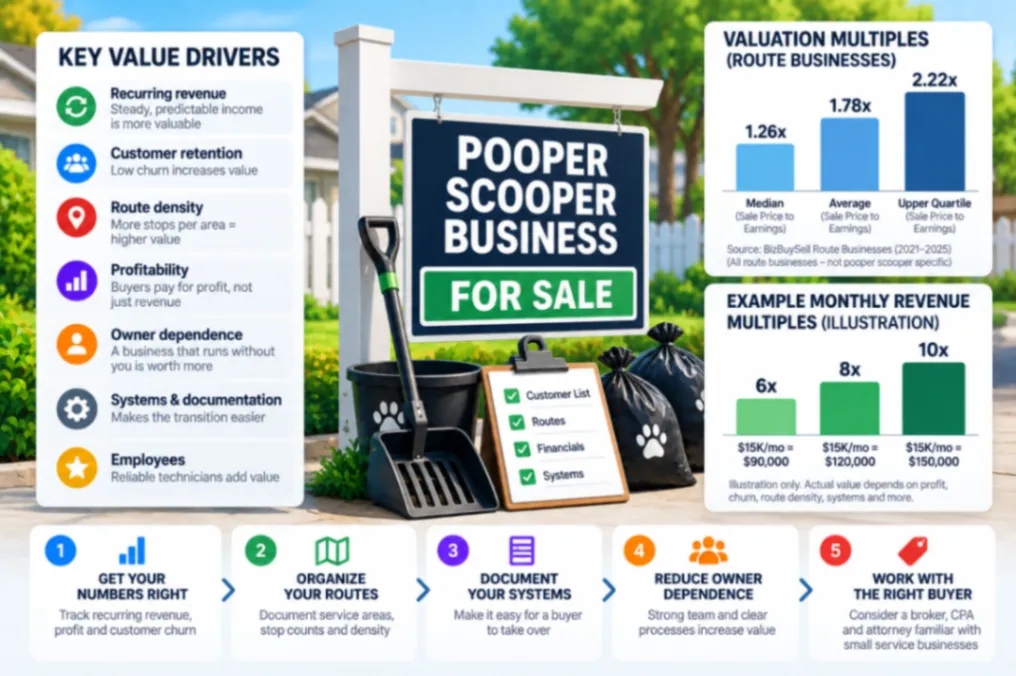
If you want to sell a pooper scooper business, the number of customers isn’t enough to determine what it’s worth.
Two companies can each have 300 customers and have dramatically different values.
One might have dense routes, autopay, clean books, employees, stable recurring customers and documented procedures.
The other might depend entirely on the owner and have customers scattered across a 60-mile service area.
A buyer isn’t just buying revenue.
They’re buying the likelihood that the revenue and profit survive after you leave.
How Small Route Businesses Are Valued
There isn’t enough public transaction data to claim that pooper scooper companies universally sell at one specific multiple.
So be careful when someone says, “Scooping businesses are worth X times revenue.”
Broader route-business data gives us a useful reference point.
BizBuySell analyzed 2,914 route businesses and reports that businesses sold from 2021 through 2025 had a median sale-price-to-owner-earnings multiple of 1.26, an average of 1.78, and an upper quartile of 2.22. Its route category includes different service and delivery routes, so these are not pooper-scooper-specific multiples. BizBuySell
Pool routes provide another comparison because they’re recurring, route-based home services. Public pool-route sources commonly value routes using multiples of monthly recurring service revenue. One 2026 dataset of 2,893 pool-route records reported a 10x median monthly-revenue multiple. Again, that’s pool service, not poop scooping. PoolDial
Use comparable industries as context, not as a guaranteed valuation formula.
Route Sale vs. Business Sale
There’s an important distinction.
You might sell:
A route: essentially a group of recurring customer accounts.
Or:
A company: customer accounts plus brand, website, phone numbers, employees, vehicles, systems, software, reputation and operating infrastructure.
A company that can continue operating without you may be worth more than a customer list that requires the buyer to recreate the business around it.
What Buyers Actually Care About
1. Recurring revenue
A weekly customer who has stayed for years is generally easier to underwrite than unpredictable one-time cleanup revenue.
Document your monthly recurring revenue separately from one-time work.
2. Customer retention
Buyers want to know how much of the customer base is likely to remain after the ownership change.
Track cancellations.
More importantly, track why customers cancel.
3. Route density
Twenty stops in one neighborhood are operationally different from twenty stops spread across an entire metro.
Dense routes mean less drive time between revenue-producing stops.
Map your routes before selling.
4. Profit
Revenue gets attention.
Profit pays the buyer.
Keep clean financial statements and be prepared to explain legitimate owner add-backs rather than trying to sell someone on gross revenue alone.
5. Owner dependence
Ask yourself:
If I disappeared for 30 days, what would break?
If the answer is sales, scheduling, customer service, payroll, route management and field service, the buyer isn’t purchasing a self-running company.
They’re purchasing your job.
6. Employees
Reliable technicians can make a transition easier, assuming they’re likely to remain after a sale.
Have documented compensation, responsibilities, training and performance expectations.
7. Systems and documentation
Document:
- Customer onboarding
- Pricing
- Route creation
- Gate/access procedures
- Service standards
- Billing
- Complaints
- Hiring
- Technician training
- Sales follow-up
- Cancellation handling
The less knowledge trapped in your head, the easier the business is to transfer.
Example of Why the Multiple Matters
Suppose a route produces $15,000 per month in recurring service revenue.
At 6x monthly recurring revenue, that’s $90,000.
At 10x, that’s $150,000.
Those are illustrations, not claims that your scooping route deserves either multiple.
The $60,000 difference illustrates why buyers care about quality.
A buyer may pay more for predictable customers, low churn, tight geography and clean operations because there’s less perceived risk.
How to Prepare to Sell a Pooper Scooper Business
Ideally, start preparing 12 to 24 months before you want out.
Clean up your bookkeeping.
Separate personal expenses.
Track recurring revenue.
Measure churn.
Document routes.
Reduce owner dependence.
Get customers onto consistent billing systems.
Document employee roles.
Keep equipment and vehicle records.
Make sure contracts, domains, phone numbers and other business assets can actually transfer.
Then talk to a business broker, CPA and transaction attorney familiar with small service businesses.
The best time to make your pooper scooper business sellable is before you’re desperate to sell it.
Build the company as though someone else will eventually own it.
Even if you never sell, you’ll probably end up with a better business.