
How Much Should You Pay Pooper Scooper Technicians? (Hourly vs. Per-Stop)
Learn how much to pay pooper scooper employees and compare hourly versus per-stop technician compensation. Includes real compensation math, productivity incentives and what to consider before choosing a pay structure.
By Poop Scoop Academy
Figuring out how much to pay pooper scooper employees isn’t just about finding the lowest wage someone will accept.
Technician compensation affects hiring, retention, route productivity and ultimately how much margin is left after servicing a yard.
There are two common ways to think about field compensation:
hourly pay and production-based/per-stop pay.
Both can work.
But they create different incentives.
What Does the Labor Market Pay?
There isn’t a reliable national government wage category called “pooper scooper technician.”
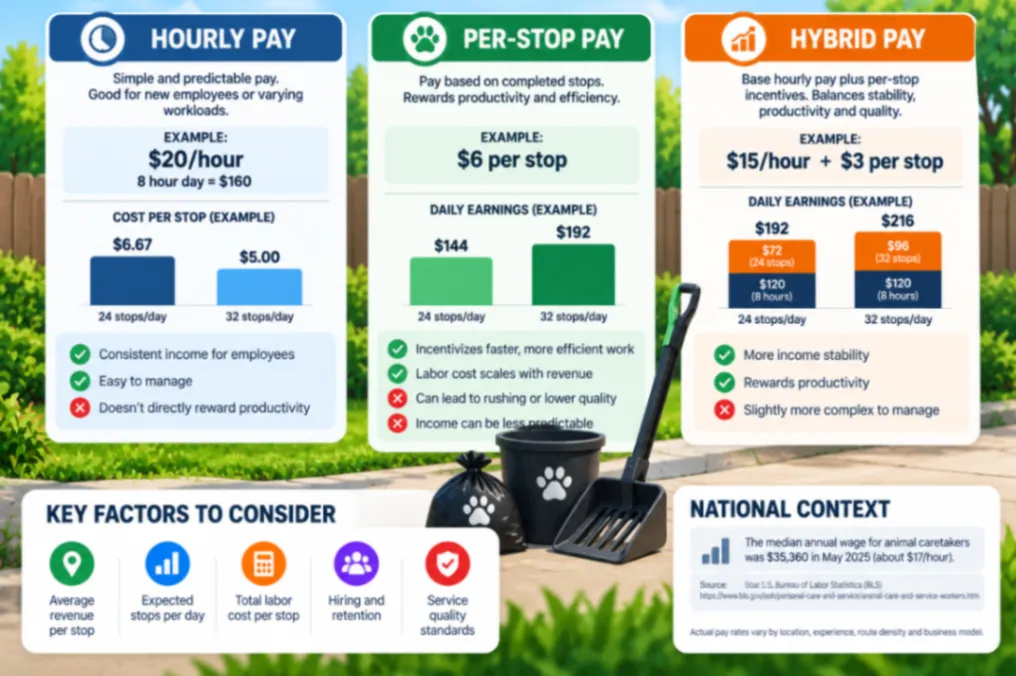
The closest broad BLS category is animal caretakers, which had a $35,360 median annual wage in May 2025. That’s roughly $17 per hour when divided across a standard 2,080-hour work year, but the category includes many jobs unrelated to route-based pet waste removal. Use it as labor-market context, not a scooper-specific wage benchmark. Bureau of Labor Statistics
Your actual rate needs to reflect your local labor market, driving requirements, working conditions and productivity expectations.
Model 1: Hourly Pay
Suppose you pay a technician $20/hour.
If they work eight paid hours:
8 × $20 = $160 in base wages
Now compare two routes.
Technician A completes 24 stops.
$160 ÷ 24 = $6.67 base wage cost per stop
Technician B completes 32.
$160 ÷ 32 = $5.00 per stop
Same employee wage.
Very different unit economics.
And that’s before payroll taxes, workers’ compensation, benefits or other employer costs.
Advantages of hourly pay
It’s simple.
Employees know what they’ll earn.
Bad weather, difficult cleanups and inefficient routes don’t unexpectedly destroy their paycheck.
Disadvantage
Pure hourly compensation doesn’t inherently reward productivity.
If faster work simply means getting assigned more work for the same hourly rate, the employee has limited financial incentive to become dramatically more efficient.
Model 2: Per-Stop Pay
Now suppose, purely as an illustration, you paid $6 per completed stop.
At 24 stops:
24 × $6 = $144
At 32 stops:
32 × $6 = $192
Productivity now directly affects compensation.
That’s attractive for a route business because labor cost scales more directly with completed revenue-producing work.
But it creates another risk.
You don’t want technicians rushing through yards, missing waste, leaving gates open or sacrificing service quality just to increase stop count.
Any production-based system needs quality controls.
Model 3: Hybrid Compensation
A third option combines a base hourly wage with production incentives.
For example, you could pay an hourly base and create bonuses tied to measurable performance.
The exact structure should be designed with your payroll and employment advisers.
The goal is to balance:
income stability + productivity + quality
rather than optimizing for only one.
Don’t Confuse Per-Stop Pay With Contractor Status
This is important.
Paying someone by the job or stop does not automatically make them an independent contractor.
The IRS considers behavioral control, financial control and the nature of the relationship. Instructions about when, where and how someone works can point toward employee status. Internal Revenue Service
The IRS also notes that work constituting a key activity of the business and an indefinite ongoing relationship can indicate an employer-employee relationship. Internal Revenue Service
Talk to a payroll or employment professional rather than assuming a 1099 solves the problem.
Work Backward From Route Economics
Instead of asking only, “What’s the going wage?”, calculate:
Revenue per stop
minus
direct technician labor per stop
minus
vehicle/drive cost
minus
supplies and processing
equals
contribution available for overhead and profit
Then model technician compensation at different productivity levels.
Your pay plan needs to work at 20 stops per day, not just 35.
Retention Matters Too
The cheapest technician isn’t necessarily the cheapest employee.
Hiring and retraining repeatedly has a cost.
So does poor service.
Your compensation system should make your best technicians want to stay while still making financial sense for the company.
The right answer may differ by market and route density.
Build the math first.
Then design the incentives.