
Is a Pooper Scooper Business Profitable? Understanding the Real Economics
Is a pooper scooper business profitable? It can be, but customer count alone doesn't determine profit. Learn how recurring revenue, pricing, route density, labor, CAC and retention determine whether a pet waste removal company actually makes money.
By Poop Scoop Academy
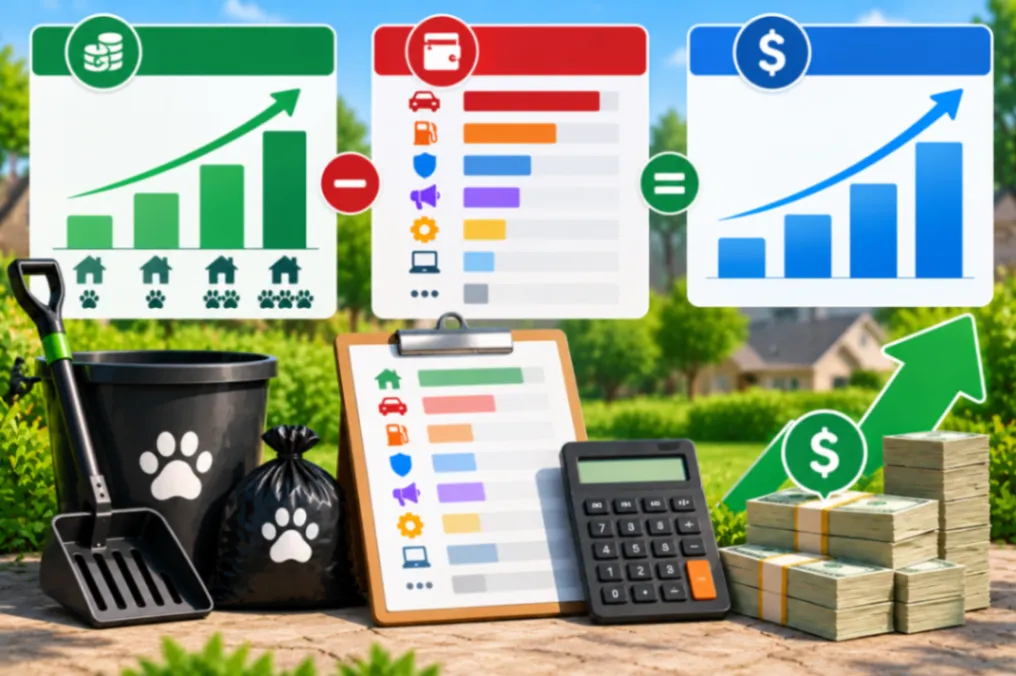
Is a Pooper Scooper Business Profitable?
A pooper scooper business can be profitable, but the service itself doesn’t guarantee profitability.
That’s an important distinction.
Picking up dog poop is operationally simple. Building routes that produce enough revenue after labor, driving, advertising and overhead is where the actual business comes in.
You can have a lot of customers and still create a weak company.
You can also have fewer customers and surprisingly good economics if they’re priced correctly and concentrated geographically.
Why the Business Model Can Work
Pet waste removal has one particularly attractive characteristic:
The problem comes back.
Dogs don’t stop producing waste after you’ve cleaned the yard.
That creates an opportunity for recurring service.
Instead of constantly finding a completely new customer for every job, you can build a base of customers who need weekly or otherwise recurring service.
Recurring revenue can make planning easier.
But recurring doesn’t automatically mean profitable.
Profit Starts With Revenue Per Stop
Suppose, as an illustration, a weekly stop produces $22.
Now suppose the direct cost of servicing that stop is $10.
That leaves $12 before advertising and overhead.
If inefficient routing pushes the direct cost to $17, the exact same customer produces only $5 before overhead.
The selling price didn’t change.
The operational efficiency did.
That’s why asking what a pooper scooper “charges” only tells you half the story.
Route Density Is One of the Biggest Levers
Driving is expensive because customers generally aren’t paying you specifically for the time between yards.
Your technician is still being paid.
Your vehicle is still moving.
Fuel is still being consumed.
But no yard is being serviced.
Dense routes allow a technician to spend a greater percentage of the day doing revenue-producing work.
PSA’s route-density guide goes deeper into building profitable pooper scooper routes. Poop Scoop Academy
Customer Acquisition Cost Matters
CAC means customer acquisition cost.
If you spend $1,000 on advertising and acquire 10 new recurring customers:
$1,000 ÷ 10 = $100 CAC
That’s an illustration.
Whether $100 is excellent or terrible depends on what those customers are worth.
If they cancel almost immediately, the economics may be poor.
If they stay for years, that acquisition cost looks very different.
This is why you should measure customers, not just leads.
Retention Can Make or Break Profitability
Imagine adding 30 customers every month.
Sounds great.
But if you’re losing 25, net growth is only five.
You’re continually paying to refill a leaking bucket.
Now imagine another company adds 15 but loses only five.
It acquires fewer customers but grows twice as much.
Retention affects the return you receive from your marketing, route density and recurring-revenue base.
Labor Changes the Business
A solo operator and an employee-run company should not be evaluated identically.
As a solo owner, you’re supplying both capital and labor.
When you hire technicians, the company has to generate enough revenue to pay someone else to perform the work while still covering everything else.
That’s when metrics such as these become increasingly important:
Stops per labor hour
Labor cost per stop
Revenue per route hour
Revenue per technician day
Hiring can make the business scalable.
It also exposes weak pricing and inefficient routes very quickly.
What About Profit Margins?
There isn’t reliable public data establishing one universal net profit margin for independent pooper scooper businesses.
So be skeptical of anyone confidently telling you that “poop scooping businesses make a 40% margin” without defining the business model or providing evidence.
A solo owner who performs all labor and calls what’s left “profit” will naturally show different numbers from a company paying technicians and managers.
Calculate your own margin:
Revenue - expenses = profit
Then:
Profit ÷ revenue × 100 = profit margin
Just make sure you’re accounting for owner labor appropriately when comparing your business with someone else’s.
What Makes a Pooper Scooper Business More Profitable?
Focus on a handful of levers:
Charge appropriately.
Build dense routes.
Retain customers.
Control customer acquisition cost.
Track technician productivity.
Avoid unnecessary overhead.
Automate repetitive administrative work where it makes economic sense.
None of those is exciting on its own.
Together, they determine whether a route produces actual profit.
The Bottom Line
So, is a pooper scooper business profitable?
It certainly can be.
But don’t confuse a simple service with an automatically profitable company.
The operators who understand pricing, route economics, retention, labor and customer acquisition have a much better foundation for building something sustainable.
For more on the revenue side, read PSA’s guide to how much money a pooper scooper business can make. Poop Scoop Academy
And if you’re building your own company, Poop Scoop Academy exists specifically to help scoopers learn from other scoopers rather than figuring out every part of the business alone.