
Pooper Scooper Route Optimization: How to Spend Less Time Driving and More Time Scooping
Better pooper scooper route optimization means less drive time and more revenue-producing stops. Learn how to organize service days, measure route efficiency, add new customers intelligently and know when a route should be split.
By Poop Scoop Academy
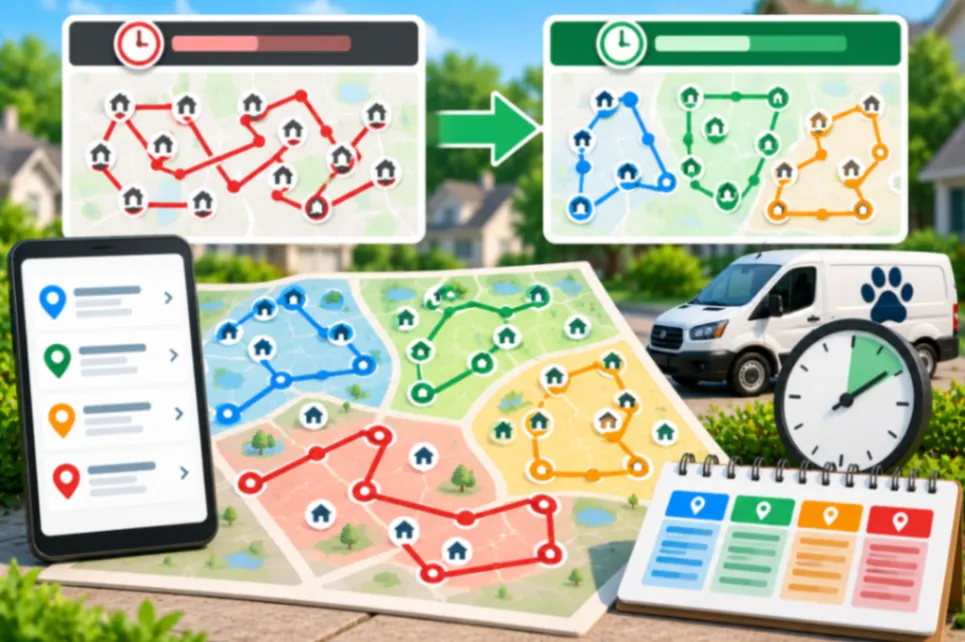
Pooper Scooper Route Optimization Is Really About Time
If you’re running a pet waste removal company, one of your most limited resources isn’t dog owners.
It’s route time.
Every working day contains a fixed number of hours.
You can spend those hours scooping yards or driving between them.
That’s why pooper scooper route optimization becomes increasingly important as your customer base grows.
The goal isn’t simply to find the shortest line on a map.
It’s to build recurring service days that let technicians complete more revenue-producing work with less wasted movement.
Route Density and Route Optimization Aren’t Exactly the Same
They’re related.
Route density describes how closely your customers are located.
Route optimization is how efficiently you sequence and schedule those customers.
You can optimize a geographically terrible route and it will still be geographically terrible.
That’s why the best route optimization starts before scheduling.
It starts with where you acquire customers.
Give Areas Specific Service Days
Instead of sending technicians everywhere every day, consider grouping geographic areas.
For example:
Monday: northwest area
Tuesday: central neighborhoods
Wednesday: eastern suburbs
That’s only an illustration.
Your actual structure should follow your customer geography.
The important principle is that recurring customers should gradually form predictable geographic clusters.
Stop Asking Only “Can We Service This Customer?”
Ask:
Where does this customer fit?
A new signup five minutes from ten existing Tuesday customers is operationally attractive.
A signup 25 minutes beyond your furthest customer may be less attractive even at the same price.
That doesn’t automatically mean rejecting them.
Maybe you’re deliberately building a new route there.
But make that decision intentionally.
Measure Stops Per Hour
One of the simplest metrics is:
Completed stops ÷ paid route hours = stops per hour
Suppose a technician completes 24 stops in eight hours.
24 ÷ 8 = 3 stops per hour
If a routing change lets the same technician complete 28 stops during the same eight hours:
28 ÷ 8 = 3.5 stops per hour
That’s a 16.7% increase in completed stops without increasing paid hours.
This is an illustration, not an industry benchmark.
Your actual numbers depend on yard size, dog count, service frequency, parking, access, waste accumulation and geography.
Track Revenue Per Route Hour Too
Stops aren’t all economically identical.
A $30 stop and an $18 stop both count as one stop.
So also calculate:
Route revenue ÷ route labor hours = revenue per route hour
Now you can evaluate whether routing changes actually improve economic output.
Use Route Software, But Don’t Expect Magic
Routing software can help sequence stops efficiently.
But software cannot fix every structural problem.
If you’ve accepted customers scattered across an enormous service area, an algorithm can’t magically put those houses next door to each other.
Use technology to optimize the customers you have.
Use marketing strategy to improve the geography of the customers you acquire next.
Market Around Existing Customers
This is where marketing and operations should work together.
If Wednesday already has a strong cluster in one part of town, that area may deserve more:
- Local advertising
- Neighborhood referrals
- SEO visibility
- Yard signs where appropriate
- Community outreach
You’re not simply asking marketing to produce a customer.
You’re trying to produce the right customer in the right place.
When Should You Split a Route?
A route eventually reaches capacity.
Signs might include:
- Technicians regularly running out of time
- New customers being squeezed awkwardly into the schedule
- Long route days
- Excessive overtime
- Service quality declining
- A geographic cluster becoming large enough to stand alone
At that point, reorganizing the route may make more sense than continually adding stops to the existing day.
Don’t Optimize Yourself Into Bad Customer Service
Efficiency isn’t the only objective.
A route that looks perfect on a map can fail if it creates unrealistic service windows or puts too much pressure on technicians.
The goal is:
efficient + repeatable + serviceable
not merely “shortest theoretical drive.”
Build Density First, Optimize Second
The strongest route is created through both customer acquisition and scheduling.
Choose service areas intentionally.
Acquire customers near existing customers.
Assign geographic service days.
Measure stops and revenue per labor hour.
Use route-planning software to improve sequencing.
Then reassess as the customer base grows.
PSA’s companion article on building dense, profitable pooper scooper routes goes deeper into the geographic side of the equation.
And if you’re trying to automate the administrative work around leads, customers and recurring operations while the routes grow, HomeFlow Suite is another resource built around home-service business automation.