
How Much Should a Pooper Scooper Business Spend on Marketing?
How much should a pooper scooper business spend on advertising? Learn how to set marketing budgets using CAC, conversion rates, lifetime customer value and channel economics instead of arbitrary percentages.
By Poop Scoop Academy
There isn’t one correct pooper scooper advertising cost or marketing budget.
“$1,000 a month” tells you almost nothing.
A business spending $1,000 to acquire 20 profitable recurring customers may want to spend more.
Another spending $1,000 without acquiring anyone should probably stop and diagnose the problem.
The useful question is:
How much can I afford to pay to acquire a recurring customer?
Start With CAC, Not Budget
CAC means customer acquisition cost.
The basic formula is:
Marketing spend ÷ new customers = CAC
If you spend $3,000 and acquire 20 customers:
$3,000 ÷ 20 = $150 CAC
That’s an illustration, not an industry benchmark.
Now suppose another campaign produces cheaper leads but fewer become customers.
This is why cost per lead isn’t enough.
Real Pooper Scooper Conversion Data
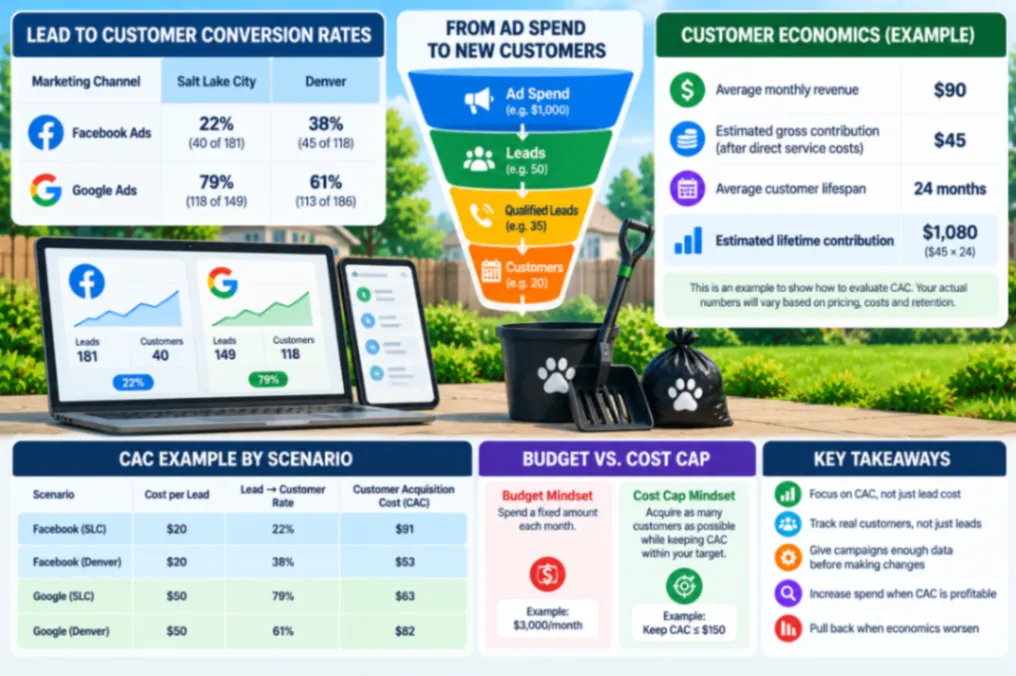
Here’s a useful example from actual operating data we’ve tracked across Salt Lake City and Denver.
Facebook:
- Salt Lake City: 181 leads → 40 customers, about 22%
- Denver: 118 leads → 45 customers, about 38%
Google:
- Salt Lake City: 149 leads → 118 customers, about 79%
- Denver: 186 leads → 113 customers, about 61%
These are actual historical business results, not universal industry benchmarks. Your market, offer, pricing, tracking and definition of a lead can produce very different results.
The lesson is more important than the specific percentages:
A lead is not a customer.
Suppose Facebook produces $20 leads but only 20% buy.
Your implied CAC is:
$20 ÷ 20% = $100
Now suppose Google produces $50 leads but 60% buy.
$50 ÷ 60% = $83.33
Google produced a lead that cost 2.5 times more, yet the customer was cheaper.
That’s why optimizing purely for cheap leads can send you in the wrong direction.
How Much Can You Afford to Spend?
Start with customer economics.
Suppose, as an illustration:
- Average customer revenue = $90/month
- Average gross contribution after direct service costs = $45/month
- Average customer life = 24 months
Estimated lifetime contribution:
$45 × 24 = $1,080
That does not mean you should happily pay $1,080 to acquire the customer.
You still have overhead, taxes, capital needs, cancellations and uncertainty.
But now you have a framework for evaluating whether a $50, $150 or $500 CAC makes economic sense.
Cost Caps vs. Marketing Budgets
This distinction is extremely useful.
A budget says:
Spend $3,000 this month.
A cost cap says:
Acquire as many qualified customers as we can while keeping economics within our acceptable range.
For a scalable campaign, the second mindset is usually more useful.
If your acceptable CAC is $150 and a channel keeps producing customers at $100, arbitrarily refusing to spend beyond $1,000 may limit profitable growth.
If CAC climbs to $400, blindly spending the rest of your monthly budget isn’t disciplined marketing.
The constraint should eventually become economics, not an arbitrary dollar amount.
Don’t Judge Campaigns Too Early
Small samples lie.
One campaign can get lucky.
Another can look terrible before producing several customers.
For our own ad analysis, we generally avoid making strong judgments about an individual campaign or creative from tiny spend levels. Roughly $300 to $500 of spend is a useful minimum before treating performance as meaningful enough for a serious evaluation, depending on the campaign economics.
That isn’t a statistical law. It’s an operating rule designed to avoid constantly changing campaigns based on noise.
Track the Funnel
For each marketing channel, track:
Spend → Leads → Qualified leads → Customers → CAC → Retention → Revenue
That lets you answer better questions.
Maybe Facebook has a higher CAC but customers stay longer.
Maybe Google is expensive but closes at a much higher rate.
Maybe SEO costs more initially but produces customers for years.
You won’t know if you stop measuring at cost per lead.
How to Set Your Marketing Budget
Start by deciding the maximum CAC your unit economics can support.
Then:
- Pick a channel.
- Spend enough to generate meaningful data.
- Track actual customers, not just leads.
- Calculate CAC.
- Track those customers over time.
- Increase spend while CAC and operational capacity remain acceptable.
- Pull back when economics deteriorate.
Your marketing budget shouldn’t be based on what another pooper scooper spends.
It should be based on what a customer is worth to your business and what it costs you to acquire one.
That’s the number that lets you scale rationally.